AetherCore
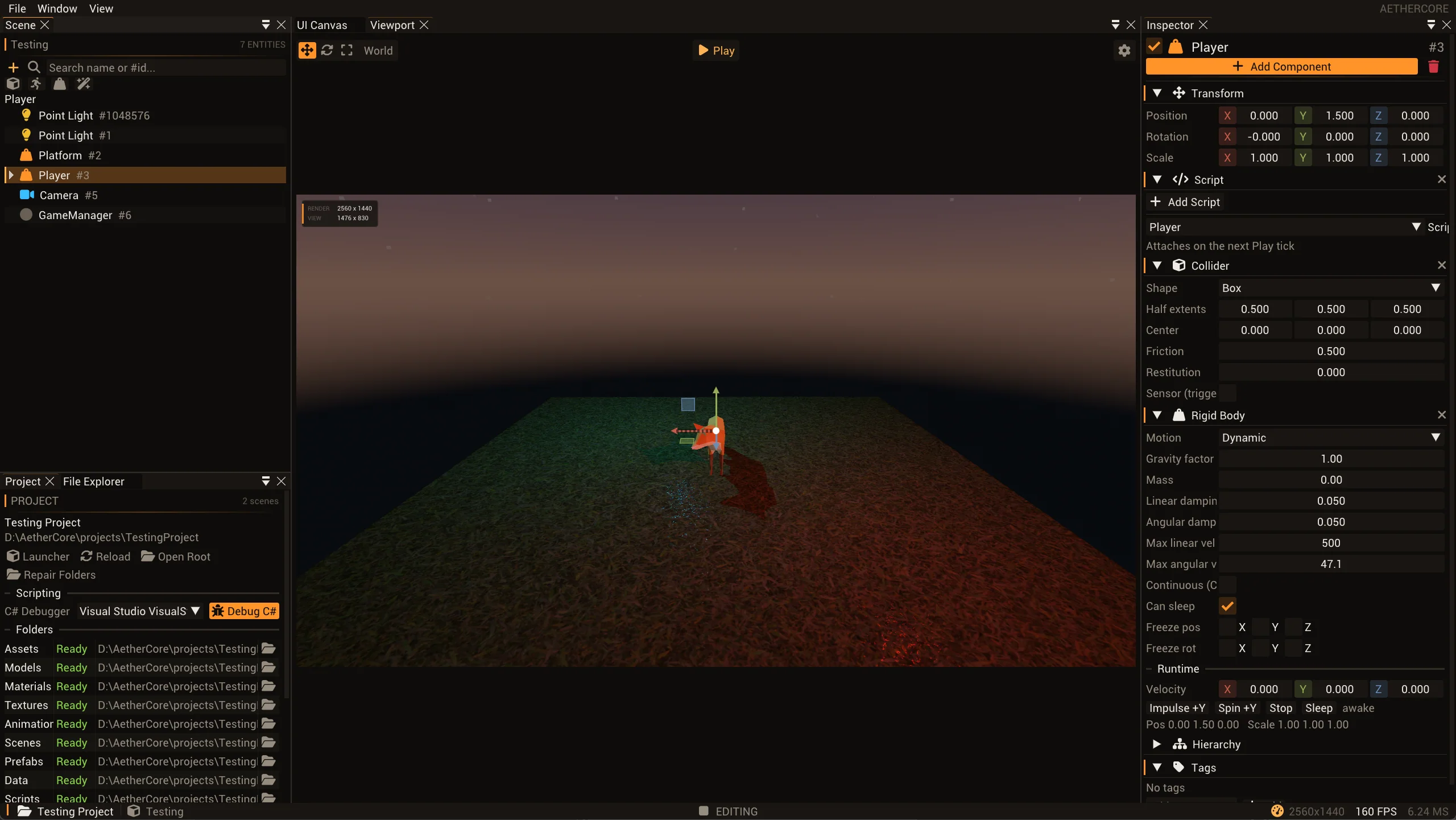
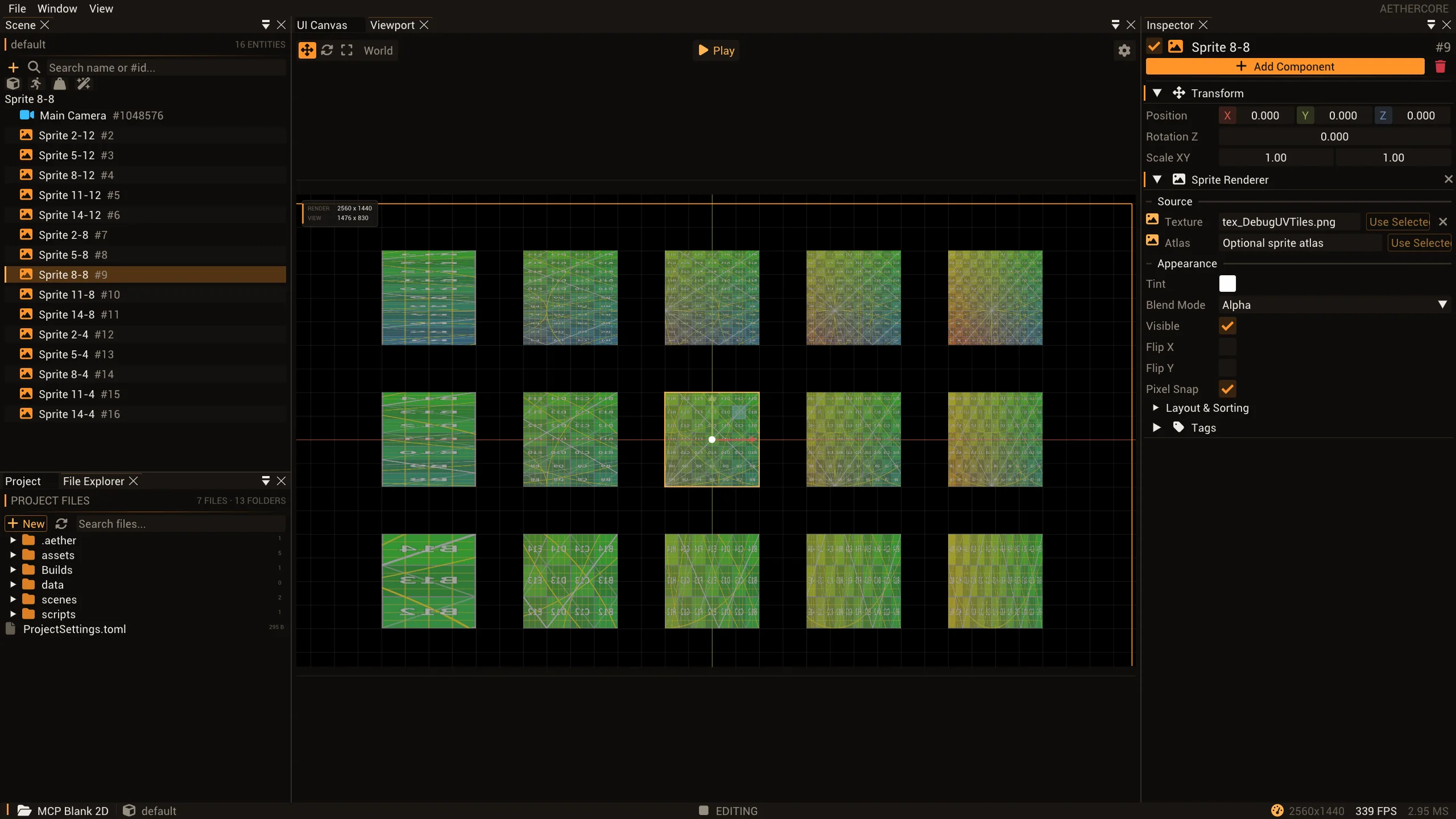
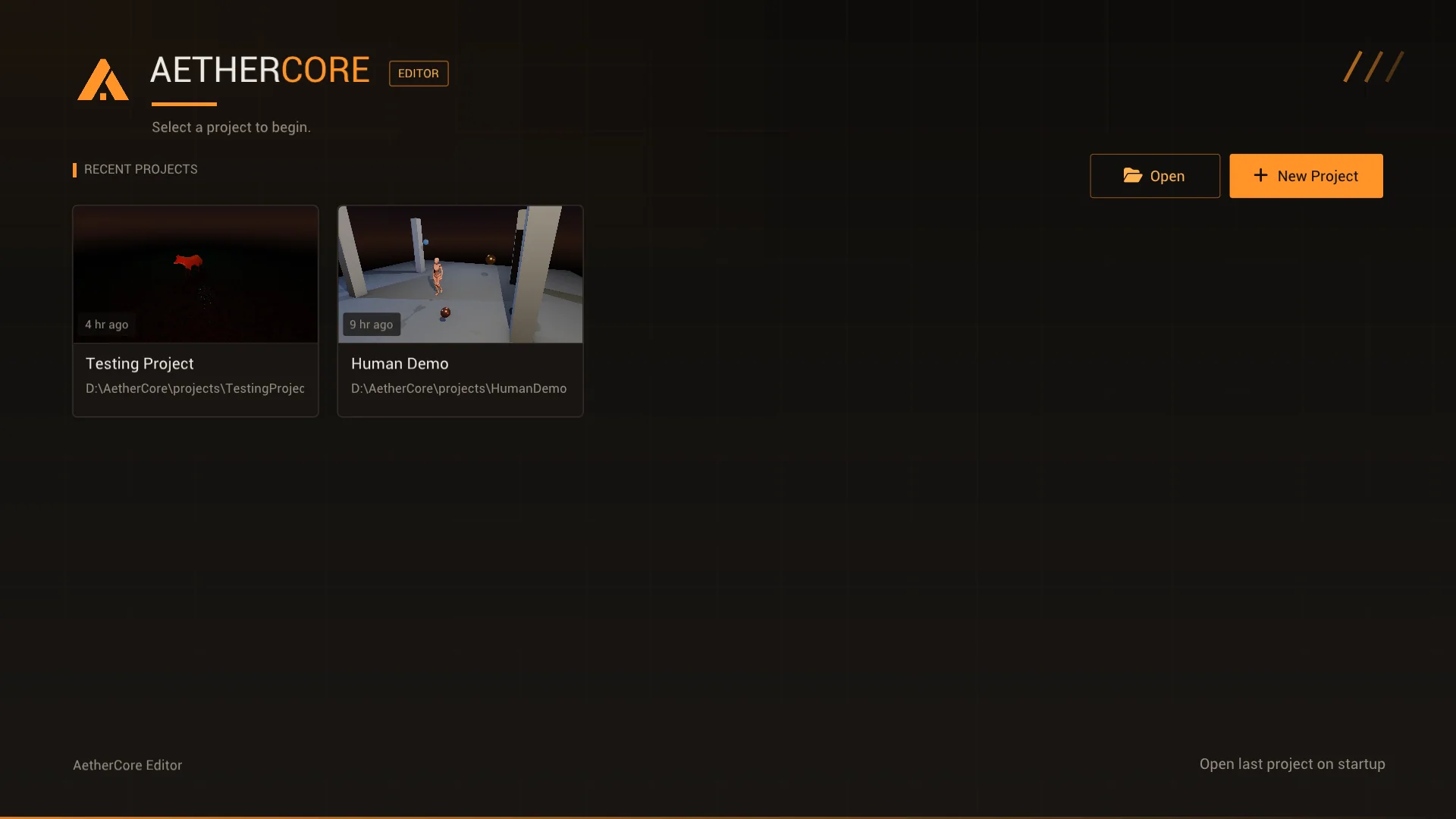
A C++/Vulkan engine with C# tooling and an MCP interface for agent-driven editor inspection, screenshots and structured validation. Developed with Oh my PI and Claude Code.
My role
Creator and sole programmer. I own architecture and development, beginning with hand-written C++/Vulkan and now directing, reviewing, verifying, and integrating agent-assisted work.
What it solves
I wanted rendering, authoring, scripting, networking and shipping to work together as a usable game engine, not remain a renderer demo.
What it delivers
- MCP tools inspect the live editor, capture screenshots and report structured pass/fail validation.
- Repository games, a physics sandbox and multiplayer test bed exercise engine systems.
- One workflow carries projects from assets and scenes to hot-reloaded gameplay, networking and packaged builds.
Key decisions
- Separated GPU interfaces from Vulkan and passed immutable render packets to isolate rendering from mutable ECS state.
- Shared component reflection across the inspector, serializer, script bindings and editor-control API.
- Built Editor, Launcher, C# SDK, diagnostics and asset processing around one project model.
Explore the technical details
Capabilities
- Render graph with bindless descriptors, buffer device address, and GPU-driven draw culling
- Tiled lighting with cascaded and local shadows, contact shadows, GTAO, and screen-space reflections
- Post-processing stack covering volumetric fog, bloom, depth of field, histogram auto-exposure, and a tonemapper with eight selectable operators
- Owner-authoritative multiplayer over ENet - network identity components, session state, and host-to-client and multicast RPCs callable from script
- Cheapest-first connect ladder of LAN broadcast, UPnP/NAT-PMP/PCP port mapping, STUN hole punching, rendezvous signalling, and opt-in TURN relay, with no port forwarding at any rung
- Editor-first 2D and 3D workflow with a standalone project Launcher, dockable viewport and inspectors, and linked prefab instances
- Authoring tools including sprite slicing, animation timelines, chunked tilemaps, a command-based undo system, and autosave with crash recovery
- Hot-reloadable .NET 10 C# gameplay SDK with collectible load contexts, inspector-exposed script fields, F5 rebuild, and one-click Visual Studio debugging
- Managed EditorGui immediate-mode API for writing editor tooling in C#
- Jolt 3D physics and Box2D 2D physics with ragdolls, character controllers, script-driven weld and rope constraints, and colliders generated from sprites and tilemaps
- Retained UI system with per-element custom shaders, inline rich-text effect spans, GPU curve text rendering, text editing, scrolling, and gamepad navigation
- Asset pipeline with glTF ingestion, freshness-checked project-wide baking, texture transcoding, material presets, zstd-compressed engine and project PAKs, and a virtual file system
- Diagnostics with Tracy CPU and GPU instrumentation, a frame timeline panel, tagged allocation tracking over mimalloc with a compile-time tracking ceiling, render-pass timings, and resource inspection
- Built-in MCP server so a coding agent can drive a live editor - managing panels, querying the render graph, capturing screenshots, and entering play mode
Verification and engineering notes
- Automated tests cover rendering, physics, scripting, assets, networking, and memory
- Static architecture checks and build-and-unit validation are complemented by local editor and runtime GPU smoke tests
- An automated GPU abstraction guard fails the build when engine code reaches past the abstraction into the Vulkan backend
- Immutable render-frame extraction keeps the render thread independent from mutable ECS state
- Per-tag allocation counters with a compile-time tracking ceiling; retail builds strip diagnostics
- Separate development, ship, and retail build policies keep diagnostics available without leaking them into release builds
- Windows and Linux build presets, with tagged releases producing a self-contained installer that needs no compiler or Vulkan SDK
Further decisions
- Designed the netcode so the owner of an entity simulates it - no round trip on your own input and no correction - and made connectivity degrade through a cheapest-first ladder so a game gets LAN play, NAT traversal, and relay fallback without a player ever forwarding a port.
- Treated the engine's own games as the acceptance test, building each subsystem against a project that needed it rather than against a demo scene.
Further outcomes
- Packaged editor builds support installation without a compiler, the Vulkan SDK, or the source repository.
- The Launcher and Editor can be driven and inspected programmatically for reproducible scene authoring, screenshots, diagnostics, and end-to-end validation.
Development workflow
AetherCore began as hand-written C++ and Vulkan. I define requirements, architecture boundaries, and acceptance criteria, then divide implementation work between agents using Oh my PI (omp) with multiple AI providers and Claude Code. I review the changes against the design and use automated tests, static architecture checks, the GPU abstraction guard, and local editor/runtime smoke tests to validate them before integration. The in-repository games provide practical acceptance cases for the engine's systems.
I wanted the engine’s systems to remain inspectable and replaceable as the toolset grew.